


In March it was sourdough. You read everything, watched every video, bought the proofing baskets, a Dutch oven and a scale accurate to a tenth of a gram. You talked about hydration ratios at dinner. You baked at midnight. By May, the starter had died in the back of the fridge, and the idea of baking felt about as appealing as doing your tax.
Now it’s vintage film cameras.
If that pattern feels familiar, you may have heard it called hyperfixation. The word gets used a lot online, especially in ADHD communities, and it often comes with a list of signs and a list of management tips. This article takes a different route. It looks at what hyperfixation actually is, the different forms it takes, why it so often ends as suddenly as it began, and what it can tell you about how your attention works.
What does hyperfixation actually mean?
Hyperfixation is an intense, absorbing preoccupation with one thing, such as a topic, a hobby, a show, a song, a food or even a person, that crowds out almost everything else for a period of time. It’s not just liking something a lot. It’s liking something so much that it starts to organise your days around it.
It helps to know where the word comes from. Hyperfixation isn’t a diagnosis, and you won’t find it in the manuals clinicians use to assess ADHD. It’s a word that grew out of lived experience, largely from neurodivergent people describing themselves online. Researchers have mostly studied a related idea, hyperfocus, and a 2018 study of adults with ADHD found they reported more intense absorption than other adults across schoolwork, hobbies and screen time.
That doesn’t make hyperfixation less real. It just means the word is descriptive rather than clinical. People use it because the existing language didn’t capture something they were living with every day.
A few features tend to come up again and again when people describe it:
- It isn’t fully chosen. Interest arrives with a force that feels more like being pulled than deciding.
- It takes up mental space even when you’re doing something else. You’re at work, but part of your brain is still planning the next step of the project.
- It runs in seasons. It might last days, weeks or months, then fade.
- It’s hard to put down for things that matter but feel dull. Meals, sleep, emails and chores tend to be the first casualties.
Isn’t that the same as hyperfocus?
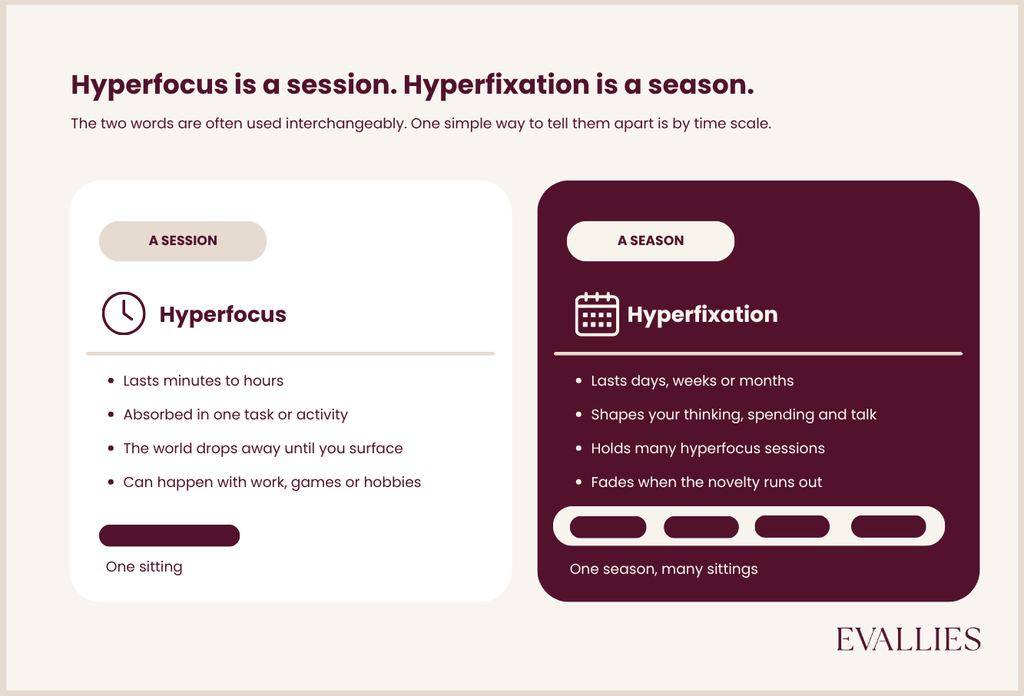
The two words are often used interchangeably, and they do overlap. One useful way to tell them apart is by time scale.
Hyperfocus is a session. It’s the four hours that vanish while you’re deep in a spreadsheet, a game or a drawing, where the outside world drops away and you surface wondering why it’s dark.
Hyperfixation is a season. It’s the weeks or months when one interest dominates your thinking, your spending, your browser tabs and your conversations. Hyperfocus happens inside hyperfixation, over and over, but hyperfixation is the bigger pattern.
Put simply, you can hyperfocus on a work report without being hyperfixated on reports. And you can be hyperfixated on a band for three months without every moment of that being hyperfocus. Sometimes it’s just playing their album on loop while you do the dishes.
How is it different from an autistic special interest?
This is where it gets more nuanced, especially because many people are both autistic and have ADHD.
Autistic people often have deep, strong interests that last for years, sometimes a lifetime. One way of understanding autistic attention, called monotropism, describes it as tending to gather into one channel at a time, pulled strongly and persistently by interest. Those interests are often a source of calm, joy and identity.
ADHD hyperfixations more often burn bright and then fade. The pull tends to come from novelty and stimulation, so once something is fully understood or no longer new, the energy can drain away.
This isn’t a strict rule. Some people with ADHD have interests that last decades, and some autistic people move between interests. People who are both autistic and have ADHD often describe having a few long-standing core interests, with shorter, intense hyperfixations cycling around them. The point isn’t to sort yourself into a box. It’s to notice which pattern sounds more like you.
What does hyperfixation look like in everyday life?
Most descriptions focus on hobbies, but hyperfixation tends to come in two quite different flavours. Recognising which one you’re in can make the experience easier to understand.
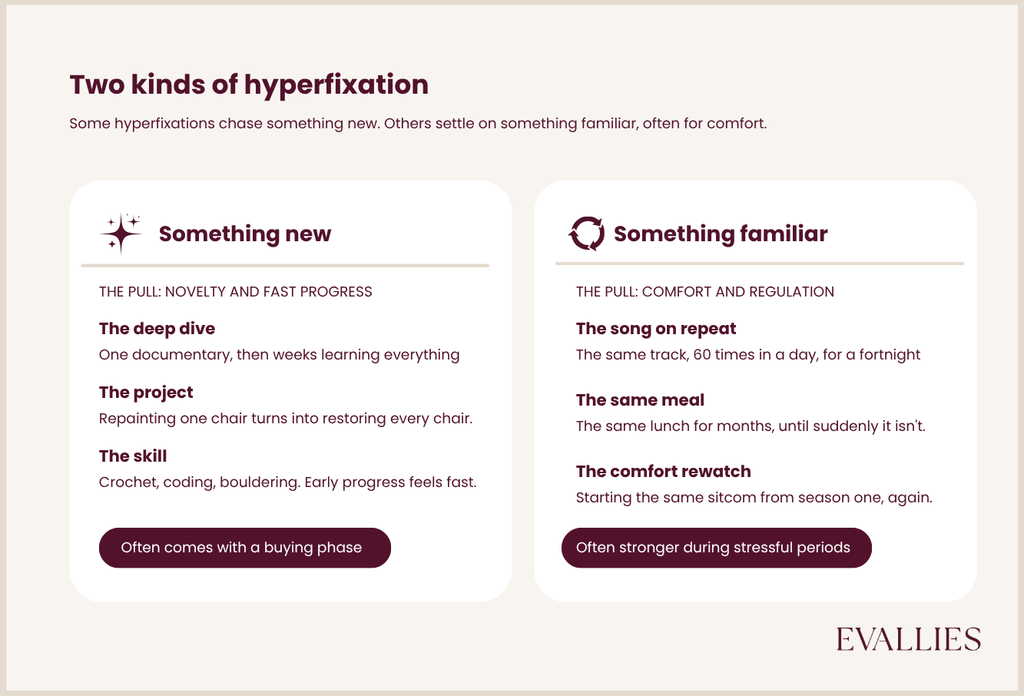
When the pull is something new
This is the version most people picture. A new interest lands and suddenly it’s everything.
- The deep dive. You watch one documentary about the Titanic and three weeks later you know the names of the ship’s officers, the layout of the boiler rooms and the competing theories about the rivets.
- The project. You decide to repaint one chair, and by the weekend you’ve stripped every piece of furniture in the house and joined three restoration groups.
- The skill. Crochet, coding, bouldering, a language. Progress in the early weeks is fast and visible, which makes it intensely rewarding.
A common thread is the buying phase. The right gear, the right books, the starter kit, the upgrade. For many adults with ADHD, the cupboard of half-used equipment is a quiet record of past hyperfixations.
When the pull is something familiar
The second flavour gets far less attention, but many people with ADHD know it well. Instead of chasing something new, the fixation settles on something predictable.
- The song on repeat. The same track, 60 times in a day, for a fortnight.
- The same meal. Eating the same lunch every day for months until, one day, you can’t face it at all.
- The comfort rewatch. Starting the same sitcom from season one for the fifth time this year.
This kind of hyperfixation often isn’t about excitement. It’s about regulation. Familiar input is easy for the brain to process, it asks nothing of you, and it can steady your mood when everything else feels like too much. People often notice these fixations get stronger during stressful periods.
Can you hyperfixate on a person?
Yes, and it’s one of the most searched and least understood forms. It can look like thinking about someone constantly, rereading their messages, learning everything about their interests and feeling an intense need for contact, often early in a friendship or relationship.
From the inside, it can feel like falling hard. The trouble is what can happen next. If the intensity fades the way other hyperfixations do, the other person may feel adored one month and overlooked the next, without understanding why. That shift is often misread as losing interest in them, when it’s more about how ADHD attention moves. It’s a pattern that comes up often for neurodiverse couples, and one that can be talked about and understood, rather than left to quietly hurt both people.
Why do ADHD brains hyperfixate?
You’ll often read that hyperfixation is “caused by low dopamine”. That’s an oversimplification, but it points in a real direction. ADHD involves differences in how the brain’s reward and motivation systems work, and that shapes what grabs attention and what doesn’t.
Is attention driven by interest rather than importance?
For many people with ADHD, the things that switch attention on aren’t importance or consequences. They’re interest, novelty, challenge and urgency. A tax return that matters a great deal can feel impossible to start. A random question about deep-sea creatures can swallow an entire evening.
Hyperfixation is what happens when something hits all of those switches at once. It’s new, it’s interesting, it offers fast progress and it’s endlessly expandable. The brain, which spends much of the day struggling to engage with things, suddenly finds something it can engage with effortlessly. That contrast is part of why it feels so good, and so hard to leave.
Why is it so hard to pull away?
Stepping away from a hyperfixation means switching from something highly stimulating to something that usually isn’t, like making dinner or replying to an email. That kind of shift relies on executive function, the brain’s ability to stop, switch and plan, which is one of the areas ADHD affects most.
Time blindness adds to it. When time is felt as “now” and “not now”, a quick look at something can turn into the whole afternoon before you’ve registered that any time has passed.
Can hyperfixation be a way of coping?
Often, yes. Daily life with ADHD can involve a lot of friction: forgetting things, running late, missing details, feeling behind. A hyperfixation offers the opposite. It’s a space where you feel capable, focused and absorbed, and where your brain finally cooperates.
That’s why hyperfixations can intensify when life gets harder. They can offer relief from stress, boredom, loneliness or low mood. That isn’t a bad thing in itself, but it’s worth noticing when an interest has quietly become the main way you get through difficult feelings.
Why does a hyperfixation end so suddenly?
This is the part most articles skip, and for many people it’s the part that hurts most.
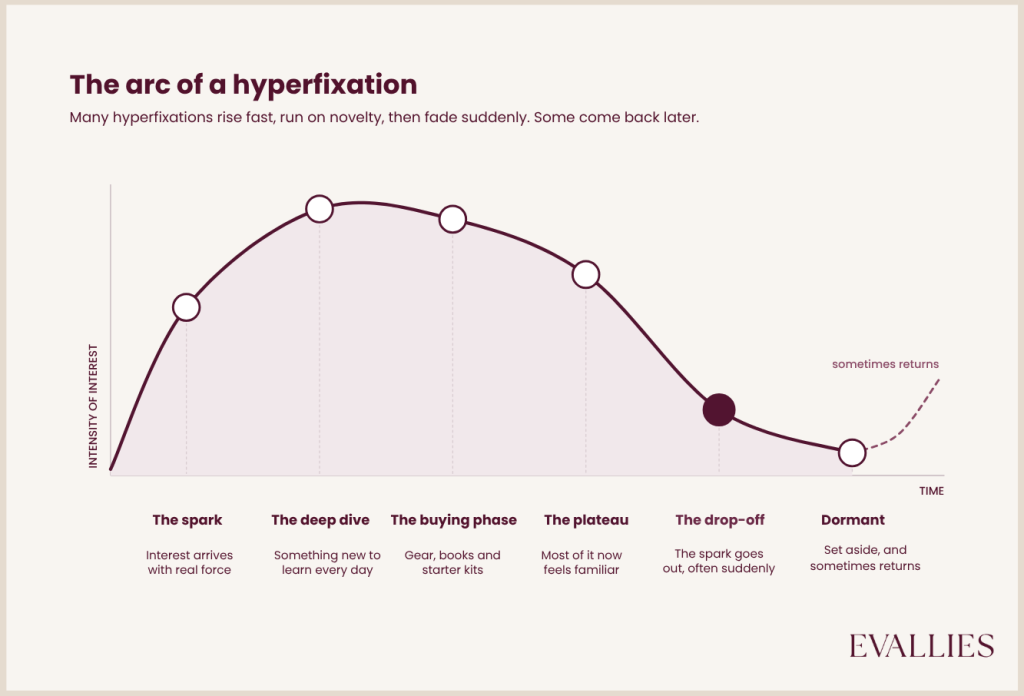
Hyperfixations rarely fade gently. More often, the spark simply goes out. One day you’re up at midnight researching aquarium filters. The next, the tank feels like a chore you can’t believe you signed up for. There’s often no obvious reason. Nothing went wrong. The interest just left.
One way to understand it is that many hyperfixations run on novelty. In the early stages, every day brings something new to learn, so the reward is constant. Once you reach a point where most of it is familiar, or progress slows and the next step looks like hard, repetitive practice, the reward drops. For a brain that runs on interest, that drop can feel like a switch turning off.
What does the drop-off feel like?
People describe a few common experiences after a hyperfixation ends:
- A strange emptiness. Something that filled your thoughts is suddenly gone, and the gap can feel flat or restless until something new arrives.
- Guilt about money and time. The equipment, the course fees, the hours. It can feel like evidence you wasted it all.
- Worry about identity. If you told everyone you were “a runner” or “a bread person”, it can feel embarrassing to stop.
- A familiar story about yourself. “I never finish anything.” “I’m flaky.” “I can’t stick at things.”
That last one is worth slowing down on. Many adults with ADHD carry years of comments about being inconsistent or not following through, and each abandoned interest can feel like more proof. For people who also experience rejection sensitive dysphoria, even a light comment like “what happened to the guitar?” can sting far more than it was meant to.
Was the time wasted?
It’s worth questioning that conclusion. A hyperfixation that lasted three months still gave you three months of absorption, enjoyment and learning. Many people find that skills from past fixations resurface later in unexpected ways: the photography that helps with a work presentation, the coding that turns into a career, the knowledge of plants that makes a new friendship click.
Some hyperfixations also come back. Interests can go dormant and return a year later with the same intensity. Seen across a lifetime, what looks like a pile of abandoned hobbies can be closer to a wide, rotating set of interests that a brain keeps returning to on its own schedule.
When might hyperfixation point to something more?
Hyperfixation on its own isn’t a problem to fix. For many people it’s one of the most enjoyable parts of how their mind works. It becomes worth a closer look when it consistently pushes out basic needs, like eating, sleeping and turning up to work, or when it’s causing real strain on money, health or relationships.
Some experiences can look like hyperfixation on the surface but are quite different underneath.
Obsessions that feel unwanted. Hyperfixation is usually enjoyable, at least while it lasts. Thoughts that are intrusive, distressing and hard to dismiss, especially when they come with an urge to check, clean, count or seek reassurance, may be more in line with obsessive compulsive disorder. The difference often comes down to whether you’re drawn towards the thought or trying to get away from it, and that distinction matters because OCD is understood and treated very differently from ADHD.
Fixations that turn into compulsions. Gaming, online shopping, gambling or social media can start as an interest and shift into something that feels hard to control, even when it’s causing harm. When stopping feels impossible and the consequences keep growing, it may be closer to addiction than hyperfixation.
Food fixations that come with restriction. Eating the same meal for months is common with ADHD. But if your range of foods is shrinking, if certain foods cause intense anxiety or disgust, or if the focus is on weight, rules or control, it may be worth exploring whether an eating disorder is involved.
Bursts of intensity alongside very little sleep. If periods of intense focus come with a reduced need for sleep, racing thoughts, unusual confidence or risk-taking, it’s worth raising with a GP, as this can sometimes be linked to bipolar disorder.
What if you’ve never been assessed?
Many adults first start to wonder about ADHD after recognising themselves in descriptions of hyperfixation. It’s a pattern that’s easy to relate to, but on its own it doesn’t mean you have ADHD. Plenty of people without ADHD get deeply absorbed in interests.
What clinicians look for is a broader picture: long-standing differences in attention, organisation, impulsivity and self-regulation that show up across different parts of life and usually go back to childhood. This includes quieter presentations like inattentive ADHD, which often goes unnoticed for years. Australia’s ADHD clinical guideline sets out how a proper assessment should work, and an adult ADHD assessment is the way to move from “this sounds like me” to a clear answer.
A Final Word
Hyperfixation is one of the most recognisable parts of living with ADHD, and one of the most misunderstood. From the outside it can look like obsession followed by flakiness. From the inside it’s often something more like this: a brain that struggles to engage with most things finds something it can engage with completely, follows it with everything it has, and then moves on when the spark runs out.
Understanding that pattern doesn’t make the dead sourdough starter any less awkward. But it can change the story you tell about it. Not “I never stick at anything”, but “my attention works in seasons”, which is a more accurate, and a much kinder, way to see yourself.